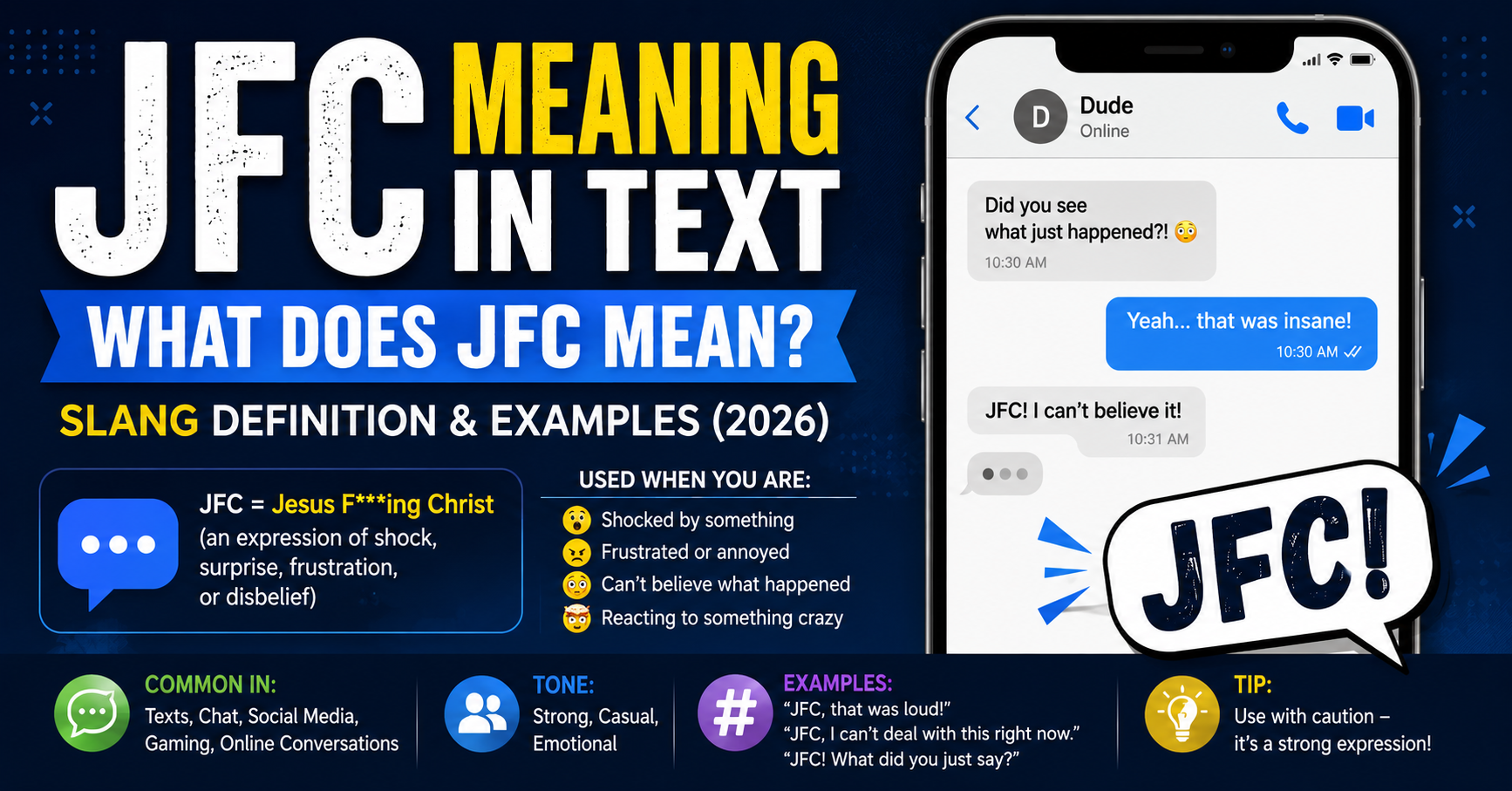
You saw “JFC” in a text and paused. It looks like a strong reaction. Maybe shock, maybe frustration. You are not alone in wondering what it means.JFC is short for “Jesus F***ing Christ.” People use it to show surprise, anger, or disbelief. It works a lot like saying “oh my god,” but with more punch. You will spot it in texts, group chats, and comments online.This guide breaks it down in simple terms. You will learn where JFC comes from and how people use it today. We will also cover real examples so you can use it the right way.
What Does JFC Stand For?
JFC stands for “Jesus F***ing Christ.” Some people soften it to “Jesus Freaking Christ” when they want a milder version. Either way, it’s an exclamation, not a literal statement about religion. Most people type it without thinking about the religious reference at all. It’s simply a fast way to react to something shocking, annoying, or unbelievable. Think of it as a stronger cousin of “OMG.”
Where Did JFC Come From?
The phrase “Jesus f***ing Christ” has been used out loud as an exclamation since at least the 1920s. It’s one of those old-school curses that got shortened once texting and typing took over.The abbreviated version, JFC, started showing up in online forums in the early 1990s. It picked up more traction as internet slang exploded, and it appeared on Urban Dictionary as early as 2003. From there, it spread into texting, gaming chats, and social media comment sections.
By the early 2010s, JFC had become common among younger internet users. It’s now a normal part of casual digital conversation, especially in group chats and comment threads.
How People Use JFC in Texting and Online Chats
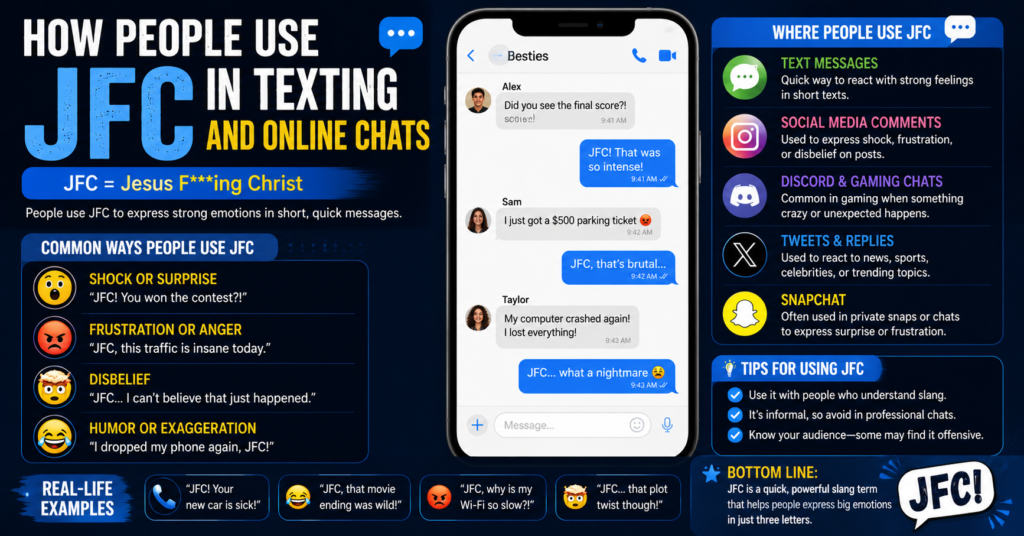
JFC almost always shows up as a reaction. Someone shares surprising news, a frustrating situation, or something chaotic, and JFC is the quick reply that captures the emotion.
It’s rarely used mid-sentence. Instead, it usually stands alone or opens a short reaction line, like “JFC, that’s insane” or just “JFC” by itself.
Tone Matters
The same three letters can read very differently depending on tone. A few common flavors:
- Annoyed tone – reacting to something irritating or inconvenient
- Shocked tone – reacting to surprising or unbelievable news
- Humorous tone – exaggerating a small problem for comedic effect
Context clues, like punctuation or emojis, usually tell you which tone the sender means.
JFC vs. Other Similar Acronyms (OMG, WTF, FFS)
JFC isn’t the only shorthand people use to express strong emotion. Here’s how it compares to a few close relatives.
| Acronym | Full Meaning | Typical Tone | Vulgarity Level |
|---|---|---|---|
| JFC | Jesus F***ing Christ | Shock, frustration, disbelief | High |
| OMG | Oh My God | Surprise, excitement | Low |
| WTF | What The F*** | Confusion, disbelief | Medium-High |
| FFS | For F***’s Sake | Annoyance, exasperation | Medium-High |
JFC tends to feel heavier than OMG because it combines a religious reference with profanity. It’s closer in weight to WTF or FFS, though each has a slightly different flavor. WTF leans toward confusion, FFS leans toward frustration, and JFC covers both shock and frustration at once.
Is JFC Offensive or Rude to Say?
JFC can come across as offensive to some people, mainly because it mixes profanity with a religious name. For casual texting among friends, it’s usually seen as harmless slang. In more formal or religious settings, it can land as disrespectful.
The best rule is simple: know your audience before you type it.
Quick Guide: Offensive or Not?
- Low risk – texting close friends who use casual language regularly
- Medium risk – family group chats or mixed-age friend groups
- High risk – religious contacts, coworkers, or people you don’t know well
Examples of JFC in Real Conversations
Seeing JFC in context makes it much easier to understand.
- Friend 1: “I just spilled coffee all over my laptop.” Friend 2: “JFC, are you serious?”
- Friend 1: “My phone just fell in the pool.” Friend 2: “JFC. Again?”
- Gamer chat: “JFC, that was such a close match.”
- Group chat: “JFC, the line at this store is not moving at all.”
In each case, JFC replaces a longer sentence with one quick burst of emotion.
When Is It Okay (or Not Okay) to Use JFC?
Like most slang, JFC fits some situations far better than others.
Okay to Use JFC When:
- You’re texting close friends who use casual or strong language often
- You’re commenting in gaming chats or informal online spaces
- You’re reacting to something genuinely shocking or frustrating in private conversation
Avoid Using JFC When:
- You’re messaging coworkers, clients, or your boss
- You’re talking with someone who holds strong religious beliefs
- You’re unsure how the other person feels about profanity
- You’re posting somewhere public and professional, like LinkedIn
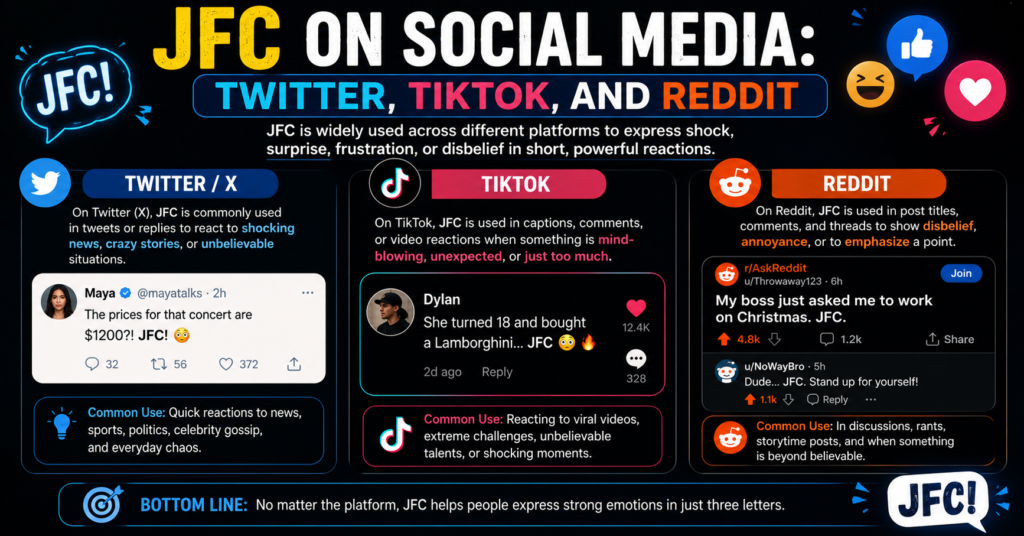
JFC on Social Media: Twitter, TikTok, and Reddit
JFC shows up constantly in comment sections and captions on platforms like Twitter (X), TikTok, and Reddit. It’s a fast way to react to a wild video, a shocking headline, or a chaotic thread without typing out a full sentence.
Reddit threads especially lean on it for reacting to unbelievable stories, since the platform’s casual tone makes strong slang feel normal. On more polished platforms like LinkedIn, though, JFC is rarely seen, since the audience and tone skew more professional.
Other Meanings of JFC You Should Know
JFC isn’t always slang for a shocked reaction. Depending on context, it can also stand for:
- Joint Forces Command – used in military and government contexts
- John F. Cena – a playful nod to the wrestler’s full name
- Jamaican Fried Chicken – occasionally used as a food-related joke or brand reference
- Just F*ing Chilling** – a casual way to describe relaxing, unrelated to the shock meaning
If JFC shows up in an unexpected context, like a business email or a menu, it’s worth checking whether the sender means the slang version at all.
How to Respond When Someone Texts You JFC
There’s no strict rule for replying to JFC. Usually, a short, matching reaction works best. A few natural responses:
- “I know, right?”
- “Seriously though.”
- “What happened?”
- A simple “😭” or “💀” emoji
If you’re not sure what triggered the reaction, asking a quick follow-up question is always a safe move.
Common Mistakes People Make Using JFC
A few slip-ups happen often with this acronym:
- Using it with the wrong audience – sending it to coworkers or older relatives who might find it disrespectful
- Assuming everyone knows the meaning – some readers may genuinely think it’s a different acronym, like Joint Forces Command
- Overusing it – repeating it constantly can weaken its impact and make texts feel less genuine
- Ignoring tone in text form – without punctuation or emojis, JFC can come across harsher than intended
Final Thoughts: Should You Use JFC in Your Texts?
JFC packs a lot of emotion into three letters, which is exactly why it’s stuck around in texting and online culture for decades. It works well among friends who don’t mind casual, strong language, and it fits naturally into gaming chats, group texts, and social media comments.
Just remember that its punch comes from a word and phrase some people find offensive. Read the room before you send it, and lean on milder options like “OMG” or “seriously?” when you’re not sure how the other person will take it.
Frequently Asked Questions
What does JFC mean in a text message?
JFC stands for “Jesus F***ing Christ,” used to express shock, frustration, or disbelief.
Is JFC a swear word?
Yes, it includes profanity within its full meaning, so it counts as mild-to-strong swearing.
Is it rude to send JFC to someone?
It can be, especially with religious contacts or in formal settings. Among casual friends, it’s usually fine.
What’s the difference between JFC and WTF?
JFC leans toward shock and frustration together, while WTF leans more toward confusion or disbelief.
Can JFC mean something other than the slang term?
Yes. It can also stand for Joint Forces Command, John F. Cena, or other unrelated phrases depending on context.
Is JFC appropriate to use at work?
No, it’s best avoided in professional or work-related messages due to its profanity and religious reference.