TL;DR Meaning: What Does TL;DR Stand For? Definition & Examples
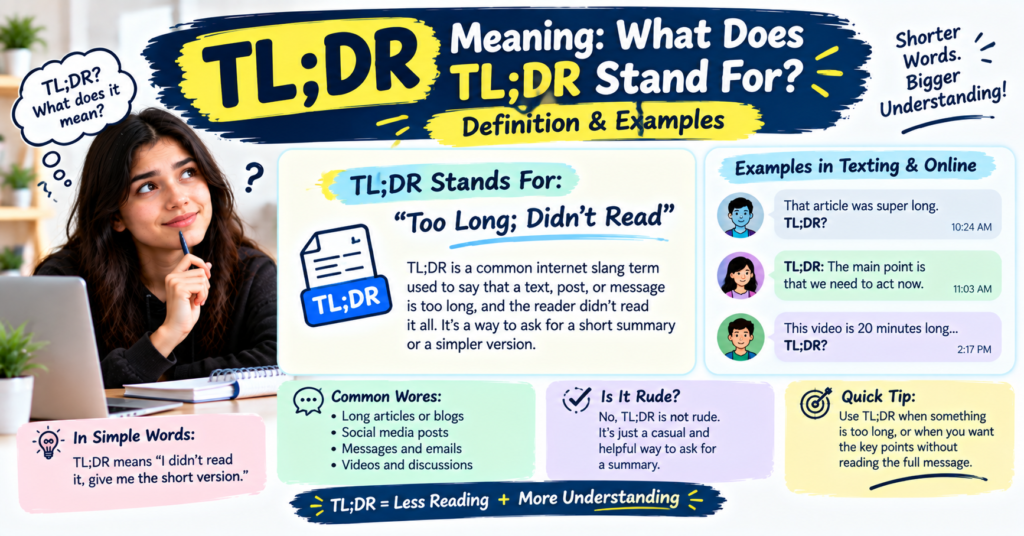
TL;DR is a short way to tell someone the main point without the full details. It stands for “Too Long; Didn’t Read.” People use it online every day. You will see it on social media, forums, and even in emails.This term helps people save time. Many articles and messages are long. Not everyone has time to read every word. A TL;DR gives a quick summary so readers get the key idea fast.Today, TL;DR is more than internet slang. Businesses use it in reports and emails. Students use it to summarize notes. Even writers add a TL;DR at the top of long posts to help readers decide if they want to keep reading.
What Does TL;DR Mean in Texting?
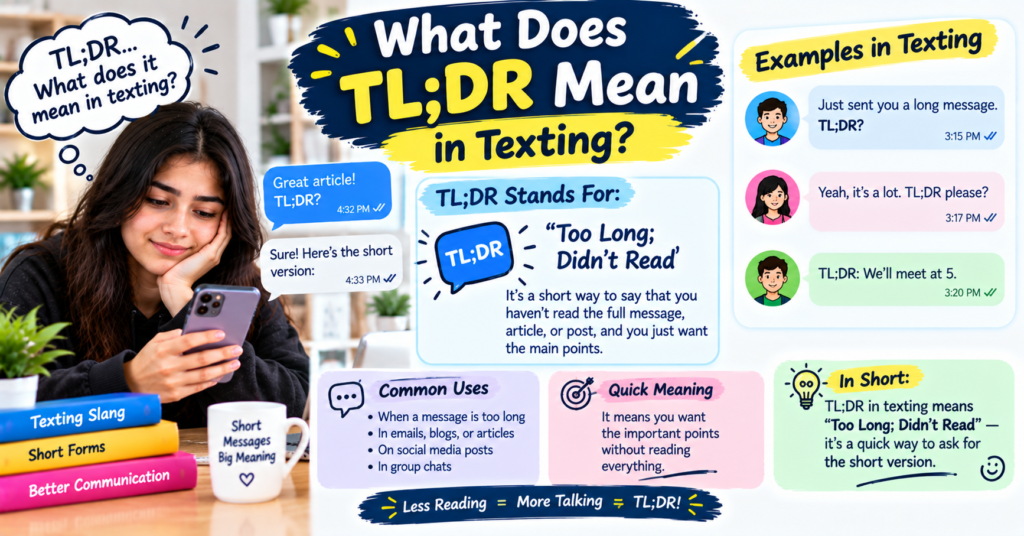
In texting, TL;DR works the same way it does online. Someone sends a long message, then adds “TL;DR” before a short version of the point. It saves the reader from scrolling through paragraphs of text on a small screen.
Friends also use it casually. If a text thread gets long and confusing, one person might jump in with “tldr?” to ask for a quick recap. It is a fast way to ask, “Can you sum this up for me?”
Here is how it usually looks in a chat:
- Long text: A detailed explanation of weekend plans, times, and locations.
- TL;DR: “We’re meeting at 7 PM at the usual spot.”
TL;DR Meaning in Simple Words
In simple words, TL;DR means “the short version.” It tells the reader: “I know this is long, so here is the quick point.” Think of it as a mini headline for a big chunk of text.
You do not need to be tech-savvy to use it. Anyone writing a long email, post, or message can add a TL;DR at the top or bottom. It works like a movie trailer — a small preview of the full story.
What Does TL;DR Mean on Social Media?
On social media, TL;DR shows up in captions, comment sections, and threads. Platforms like Reddit, X (formerly Twitter), and Facebook are full of long posts, so TL;DR helps users skim content quickly.
It also has a second use on social media. Sometimes people write “TL;DR” as a light joke or a gentle complaint when a post feels too long. It is a playful way of saying, “This could have been shorter.”
Common places you will spot TL;DR online:
- Reddit posts and comment threads
- Long Instagram or Facebook captions
- Product reviews on shopping sites
- News article summaries
- Blog posts and newsletters
TL;DR Examples in Texting and Online
Seeing real examples makes the meaning clearer. Below are a few ways TL;DR appears in everyday writing.
| Context | Example |
|---|---|
| Text message | “Ugh, long story… TL;DR: I’m running late.” |
| Reddit post | “TL;DR: The new phone has better battery life but a higher price.” |
| Work email | “TL;DR: Meeting moved to 3 PM tomorrow.” |
| Product review | “TL;DR: Great sound quality, poor battery life.” |
| Blog article | “TL;DR: Drinking more water improves focus and energy.” |
These examples show one pattern. The TL;DR line always comes with a short, clear sentence that captures the main idea.
How to Use TL;DR in a Sentence
Using TL;DR is simple once you see the pattern. You write your full message first, then add a short summary line marked with TL;DR. It usually goes at the very top or the very bottom of the text.
A few natural ways to use it in a sentence:
- “TL;DR: The project is delayed by one week.”
- “That was a lot to read — TL;DR, please?”
- “Here’s my TL;DR of the report: sales went up 12% this quarter.”
Placement Tips
- Put it at the top if readers need the point before deciding to read on.
- Put it at the bottom if you want to reward readers who finish the full piece with a clear recap.
Is TL;DR Rude or Disrespectful?
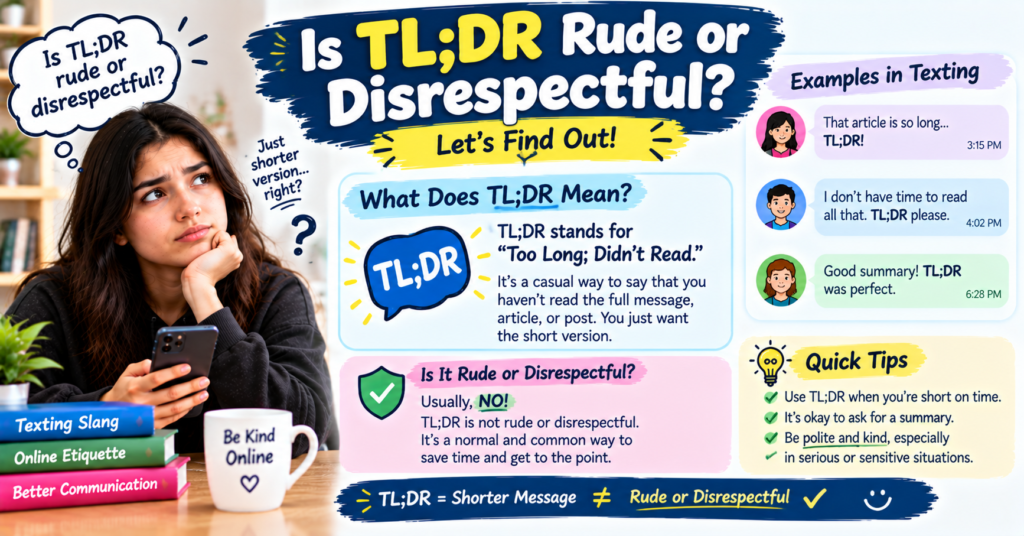
This depends on how it is used. If someone writes “TL;DR” as a way to summarize their own long message, it is helpful and polite. It shows respect for the reader’s time.
But if someone replies “TL;DR” to another person’s post without reading it, it can feel dismissive. It may come across as saying, “Your post was too long, so I ignored it.” In casual online spaces, this is usually accepted as normal internet culture. In professional settings, it is better to avoid using TL;DR this way, since it can seem rude or lazy.
TL;DR vs. Summary: What’s the Difference?
TL;DR and summary are similar, but they are not exactly the same. A summary can be several sentences or even a full paragraph. A TL;DR is meant to be much shorter — often just one line.
| Feature | TL;DR | Summary |
|---|---|---|
| Length | One short line | One or more paragraphs |
| Tone | Casual, informal | Can be formal or informal |
| Common use | Social media, texts, blogs | Reports, essays, articles |
| Goal | Give the fastest possible takeaway | Explain key points in more detail |
In short, every TL;DR is a type of summary, but not every summary is short enough to be called a TL;DR.
When Should You Use TL;DR?
TL;DR works best when your content is long and detailed. It is helpful in situations where readers are busy or skimming quickly. Below are common cases where it fits well.
- When writing a long email that busy coworkers need to skim
- When posting a detailed forum comment that others may skip
- When sharing a blog post or article online
- When explaining something complex in a text message
- When writing a product review with lots of details
Avoid using TL;DR in very formal writing, such as academic papers or legal documents, where a proper summary section is more appropriate.
TL;DR Meaning and Examples Explained
To wrap up the core idea: TL;DR stands for “Too Long; Didn’t Read.” It is used to give a fast, simple summary of a longer piece of text. You will find it in texts, emails, blog posts, and social media comments.
The key to using it well is keeping the summary short and clear. A good TL;DR should let someone understand the main point in just a few seconds, even if they never read the full message.
Conclusion
TL;DR has grown from simple internet slang into a widely accepted tool for fast communication. Whether you are texting a friend, writing a work email, or posting online, adding a TL;DR shows that you respect your reader’s time. Used correctly, it makes your writing clearer and more helpful — not lazy or rude.
FAQs
What does TL;DR stand for?
TL;DR stands for “Too Long; Didn’t Read.” It is used to give a quick summary of longer text.
Is TL;DR the same as a summary?
Not exactly. A TL;DR is a much shorter, one-line version of a summary.
Can I use TL;DR in professional emails?
Yes, many workplaces accept it as a quick way to highlight key points, especially in casual teams.
Is it rude to say TL;DR to someone’s post?
It can seem dismissive if you didn’t read their post at all, but it’s fine when summarizing your own writing.
Where did TL;DR originally come from?
It started as internet slang on online forums in the early 2000s and later spread across social media and texting.
How long should a TL;DR be?
Ideally, one to two short sentences that capture only the main point.